
Summary
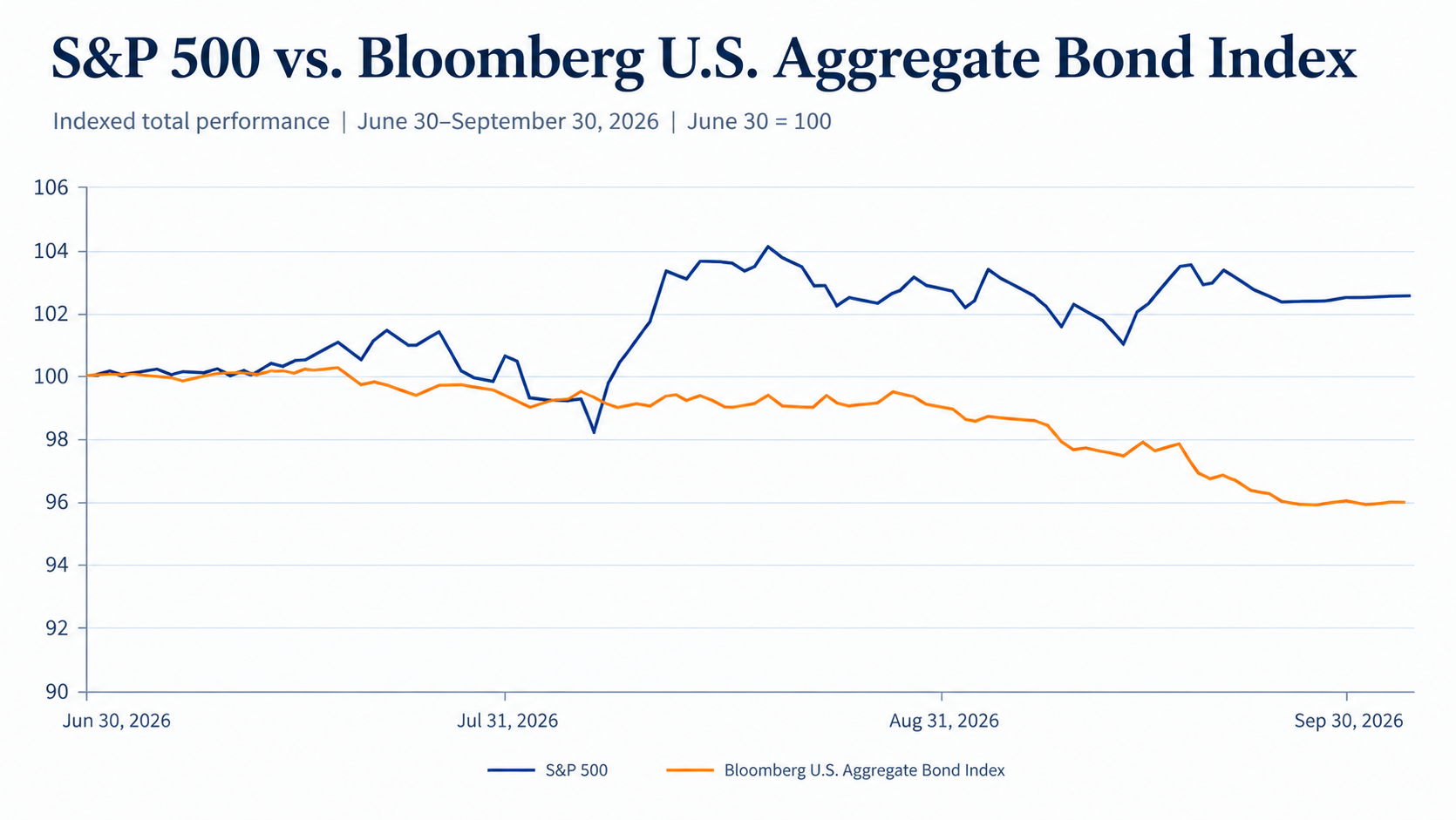
The third quarter of 2026 presented investors with a challenging mix of market headwinds, including rising energy prices and higher interest rates that pressured bond prices. Yet the stock market remained resilient, supported by strong corporate earnings and solid U.S. household spending.
The result was a quarter of diverging returns across asset classes, market capitalizations, and investment sectors.
Equity Markets
The S&P 500 gained 2.5% during the quarter, while the S&P 500 Equal Weighted Index declined 2.1%. This divergence reflected the outsized influence of a handful of mega-cap AI and technology stocks on overall market performance. At the sector level, Energy and Technology led the market, while Utilities and Industrials lagged.
International equities, as measured by the MSCI World ex USA Index, returned 1.1%. Meanwhile, small-cap stocks, represented by the Russell 2000, declined 6.9% following gains of more than 20% during the first half of the year.
Economy
The economic backdrop remained mixed. The 10-year Treasury yield climbed above 5.25%, reaching a 24-year high, while mortgage rates moved above 7%. Higher corporate borrowing costs can weigh on the economy particularly on rate-sensitive sectors such as housing while also increasing financing costs for businesses.
Increased Middle East tensions contributed to oil price volatility. Brent Crude Oil prices rose from approximately $71 per barrel in July to roughly $98 at the end of September. A de-escalation of the conflict involving Iran could ease energy prices and reduce inflationary pressures, although the outlook remains uncertain.
Consumer confidence remained near historic lows, according to the University of Michigan survey. Nevertheless, US household spending increased 6.1% over the 12 months ending in August, up from 4.3% growth at the end of 2025, fueled partly by higher inflation. Most Federal Reserve officials forecast of at least one further rate increase this year although an increase at the next meeting before November’s mid-term election seems less likely.
Fixed Income
Bond markets faced pressure during the quarter. Resilient economic growth, inflation concerns, substantial government borrowing and capital demands associated with AI investment contributed to higher yields and lower bond prices. The Bloomberg US Aggregate Bond index declined 3.3% for the quarter resulting in a yield of 5.6% which compares to the average yield of 3% since 2009.*
Outlook
Third quarter earnings season is about to get underway and FactSet estimates S&P 500 year over year earnings growth of approximately 29% which would represent the third consecutive quarter of earnings growth over 25%. The forward P/E of the S&P 500 of 19x compares to 20x at the start of the quarter and the 30-year average of 17.2x.* While market volatility may persist; a constructive earnings outlook, the historically seasonally strong stock market performance in the fourth quarter combined with continued economic resilience point to a solid stock market backdrop.
And while it was a tough quarter for many bondholders, today’s higher yields offer more attractive income opportunities than were available in recent years. A current yield of 5.56% for the Bloomberg US Aggregate implies a forward 5-year annualized return of 5.74%.* Bonds also provide diversification benefits with positive bond returns (as measured by the Bloomberg U.S. Aggregate Index) in 21 of the 25 years that S&P 500 stock returns were negative.*
We continue to monitor evolving economic and market conditions while managing a diversified portfolio of stocks and bonds for clients.
*JP Morgan Guide to the Markets US 4Q 2026
Sources: FactSet, Morningstar, Barron’s, The Wall Street Journal, JP Morgan Guide to the Markets, Charles Schwab & Co., Kitces
The information presented on this post is believed to be factual and up-to-date, but we do not guarantee its accuracy and it should not be regarded as a complete analysis of the subjects discussed. Comments should not be construed as an offer to buy or sell, or a solicitation of an offer to buy or sell the investments mentioned. A professional adviser should be consulted before implementing any of the strategies discussed. Investments involve varying degrees of risk, and there can be no assurance that any specific investment or strategy will be suitable or profitable for a client's portfolio. All investment strategies can result in profit or loss.