
Market volatility returned in Q1 2026 as the war in Iran intensified. One of the clearest indicators of shifting investor sentiment was the sharp rise in the CBOE Volatility Index (VIX) which climbed from 14.95 at the end of 2025 to an intra-quarter high of 31.65 in late March.
At the same time, energy markets reacted swiftly. Brent Crude Oil prices surged above $100 per barrel for the first time since 2022, driven in part by supply disruptions linked to the closure of the Strait of Hormuz. The Strait of Hormuz normally transports a fifth of the world’s oil and liquefied natural gas (LNG).
Inflation concerns resurfaced, prompting a more hawkish tone from the Federal Reserve. The combination of rising oil prices, geopolitical risk, and tighter monetary expectations weighed on global equities. The S&P 500 Index declined 4.6% during the quarter, marking the weakest performance since 2022.
Periods like this can challenge even seasoned investors but history continues to suggest that trying to time the market can be costly. A recent study from JP Morgan (depicted below) found that investors who remained fully invested in the S&P 500 from 2006 through 2025 achieved an annualized return of 11%. Missing just the 10 best days in the market reduced returns to 6.6% and missing the 40 best days resulted in negative returns overall.
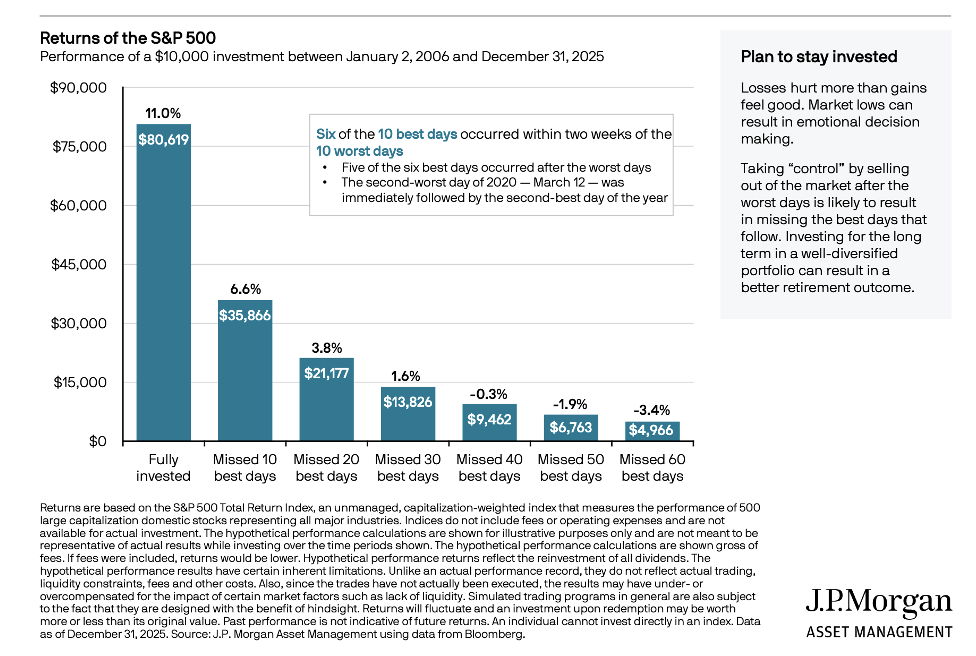
Even recent market action reinforces this point. On April 8, 2026, the S&P 500 rose 2.5% in a single day following news of a ceasefire with Iran. While not among the largest single day gains historically, it serves as a clear reminder how quickly markets can rebound.
Despite the volatility, underlying fundamentals remain supportive. Corporate earnings continue to show strength, with S&P 500 earnings expected to grow approximately 13% in Q1 2026. If realized, this would mark the sixth consecutive quarter of double-digit earnings growth. Looking ahead, full-year earnings are expected to grow by 18%.
At the same time, valuations have also moderated, with the S&P 500 trading closer to its 10-year average. Importantly, despite elevated uncertainty, earnings estimates for the S&P 500 have been moving higher.
Market volatility, while uncomfortable, is not unusual. A well-diversified portfolio along with a regularly reviewed financial plan can help provide clarity and confidence during periods of uncertainty.
Sources: FactSet, JP Morgan Asset Management (Guide to Retirement, Jan 2026), Orion, The Wall Street Journal (April 2, 2026), XY Planning Network
The information presented on this post is believed to be factual and up-to-date, but we do not guarantee its accuracy and it should not be regarded as a complete analysis of the subjects discussed. Comments should not be construed as an offer to buy or sell, or a solicitation of an offer to buy or sell the investments mentioned. A professional adviser should be consulted before implementing any of the strategies discussed. Investments involve varying degrees of risk, and there can be no assurance that any specific investment or strategy will be suitable or profitable for a client's portfolio. All investment strategies can result in profit or loss.